

Most SMS APIs charge somewhere between a fraction of a cent and a few cents per message domestically, with international rates climbing much higher depending on the destination. Three factors move that number the most: the destination and carrier you are routing through, the type of sender number you use (long code, short code, or toll-free), and how much you spend on compliance and registration. The rest of this guide shows how to model those costs and where to cut them.
TL;DR:
- Domestic SMS costs are generally low, but international rates vary significantly depending on the destination and carrier routing.
- Additional fees for sender numbers, registration, compliance, and platform services can outweigh per-message costs in high-volume scenarios.
- Fixed costs like number rentals and setup fees remain constant regardless of message volume, making tiered plans more advantageous at higher volumes.
- Compliance requirements, such as consent capture and recordkeeping, add operational costs that can lead to higher bills if overlooked.
- Integrated platforms that combine email and SMS can reduce total costs through shared infrastructure, simplified management, and better deliverability.
Table of Contents
- 1. Pricing components on a typical SMS bill
- 2. How pricing models change your monthly bill
- 3. How to estimate your own SMS API bill
- 4. Compliance and hidden costs that inflate the bill
- 5. Practical ways to lower your SMS spend
- 6. How an integrated platform lowers total messaging cost
- 7. What developers and procurement teams should do next
- Get transparent SMS and email pricing in one plan
- Sources
- FAQ
1. Pricing components on a typical SMS bill
An SMS invoice is rarely just "messages sent times a rate." Several line items stack together, and missing one is how budgets get blown.
The base charge is per-message unit pricing, but that unit is often a segment rather than a full text. A message with more than 160 characters (or 70 for certain Unicode encodings used in some languages) splits into multiple segments, and each segment bills separately. Emoji and non-Latin characters can quietly double the segment count without changing the visible message length.
Destination and carrier surcharges add another layer. Domestic routes usually cost less than international ones, and even within a single country, some carriers charge more to terminate traffic than others, a difference the provider passes through as a routing fee.
Sender identity is its own cost category:
- Long codes (standard 10-digit numbers) typically carry a small monthly rental fee.
- Dedicated short codes cost more to lease and often require a separate registration process with the carrier.
- Toll-free numbers for SMS need their own verification and registration before they can send at volume.
On top of that sit platform fees: monthly subscription tiers, higher SLA levels, onboarding assistance, and identity verification. Finally, operational costs creep in through retries on failed sends, processing charges for undelivered messages, and reporting or analytics features some vendors bill separately.
Pro Tip: Ask any SMS vendor for a full line-item quote, not just a per-message rate. The number rental and registration fees often matter more than the unit price once you are past a few thousand messages a month.
2. How pricing models change your monthly bill
Vendors package these components into a handful of pricing structures, and the right one depends on your volume and predictability.
- Pay-as-you-go works well for low or unpredictable volume, but it rarely includes volume discounts, so it stops scaling economically once you cross a few hundred thousand messages a month.
- Committed or tiered monthly plans lower the marginal per-message price as volume rises, which rewards businesses that can forecast their sending with reasonable accuracy.
- Number model changes the math independently of message volume: a rented long code carries a flat monthly fee regardless of usage, a shared short code spreads registration cost across many senders, and a dedicated toll-free number front-loads a verification cost before your first send.
- Free or no-monthly-fee offers almost always cap monthly volume, throughput, or destinations, and the moment you exceed those limits the effective price per message often jumps.
Throughput and SLA commitments carry their own cost implications. A higher messages-per-second limit or a guaranteed uptime tier usually sits behind a pricier plan, and if your use case involves time-sensitive one-time codes or alerts, that throughput ceiling can matter more than the headline per-message rate.
3. How to estimate your own SMS API bill
A workable estimate needs a handful of inputs before you touch a calculator.
- Count your expected messages per day, split by transactional (receipts, codes) and marketing.
- Estimate the average segment count per message, accounting for links, personalization, and language.
- Break down destinations by country, since domestic and international rates differ substantially.
- Add fixed monthly costs: number rental, platform subscription, and any SLA upgrade.
- Add one-time costs: short code or toll-free registration, verification, and initial setup.
- Layer in expected carrier surcharges and a buffer for retries on failed deliveries.
Statistic Callout: Cloud provider free tiers, as Google Cloud's free program documentation shows, cover general API usage but do not include a free SMS gateway, since carrier billing sits outside that free tier. Budgeting SMS as if a cloud free tier will absorb it is a common and costly mistake.
Say a business sends 100,000 transactional messages and 100,000 marketing messages a month, mostly domestic, averaging 1.2 segments each. That is 240,000 billable segments before any international mix or retries are added. Run the same model at 10% higher volume and at 50% higher volume before committing to a plan, since fixed fees like number rental stay flat while segment costs scale linearly, and that gap is where a tiered plan starts to pay off.

4. Compliance and hidden costs that inflate the bill
Regulatory obligations are not optional line items, and skipping them costs more than the fees themselves.
Mobile wireless providers must block texts when notified of illegal texts, and Do-Not-Call protections now apply to text messages the same way they apply to phone calls.
The FCC's Report and Order in FCC 23-107 sets these blocking and consent obligations, and the Federal Register's summary of the same rule notes that extending Do-Not-Call protections to texts and tightening prior express written consent can raise administrative costs for businesses running marketing campaigns. A related Federal Register entry on unlawful text messages details mandatory blocking, do-not-originate lists, and recordkeeping requirements that translate directly into engineering and compliance work.
That work shows up as real costs:
- Consent capture systems that log opt-in timestamps and sources.
- Recordkeeping and suppression list maintenance to honor opt-outs permanently.
- Periodic audits to confirm consent records match actual sending behavior.
- Remediation costs when a number gets reassigned or a message gets wrongly blocked.
A low per-message rate looks attractive until a carrier blocks your traffic over a consent gap, or a compliance audit finds gaps in your opt-out records. At that point, the cheapest vendor on paper can become the most expensive one in practice.
5. Practical ways to lower your SMS spend
Cost reduction works best when it does not compromise deliverability or compliance, since a blocked message costs more than a discounted one.
- Shorten templates and use link shorteners to keep messages under the segment threshold.
- Batch and schedule noncritical sends to smooth throughput and avoid retry premiums, a pattern covered in Notix's guide to batch and scheduled sends.
- Match number type to use case: a long code for low-volume alerts, a short code only when throughput demands it.
- Move noncritical notifications to email or push where compliance and cost allow, reserving SMS for time-sensitive messages.
- Invest in consent capture and suppression list management up front, since the cost of doing it right is smaller than a blocking incident or a compliance remediation.
Pro Tip: Before adding a second number type "for safety," check whether your retry and throughput problem is actually a registration gap. Many throttling issues disappear once a number is properly registered.
6. How an integrated platform lowers total messaging cost
Notix combines email and SMS sending behind a single API, which removes a category of hidden cost that shows up when teams run separate tools for each channel.
- A single API for email and SMS cuts the engineering time spent maintaining two integrations and two sets of credentials.
- Double opt-in for contacts reduces the number of invalid or unwanted sends that would otherwise waste budget on undeliverable messages.
- Automated suppression shared across marketing and transactional messages means a single opt-out or bounce updates both channels at once, simplifying audits.
- A high uptime SLA gives predictable delivery performance without paying for a separate premium tier per channel.
- Transparent pricing means the monthly bill matches the estimate a team ran before signing up, rather than surprising them with line items discovered after onboarding.
Fewer failed sends mean fewer retries to pay for, and a simpler audit trail means less staff time spent reconciling suppression lists across tools. For teams in payments, commerce, or SaaS sending both transactional and marketing messages, consolidating onto one platform removes duplicate overhead without adding a second vendor relationship to manage.
7. What developers and procurement teams should do next
If you write the integration, start with one number type and track retries and segment counts before adding a second. If you own the budget, ask vendors for transparent pricing examples and documented compliance practices, and include registration and suppression costs in any RFP, not just the per-message rate. Both sides should run the estimation steps above and plan for consent capture before scaling volume.
— Paul
Get transparent SMS and email pricing in one plan
Notix folds email and SMS sending, one-time code verification, and suppression management into a single API, which means the cost levers covered above (fewer failed sends, simpler compliance audits, no duplicate vendor fees) are built into the platform rather than something you have to engineer yourself.
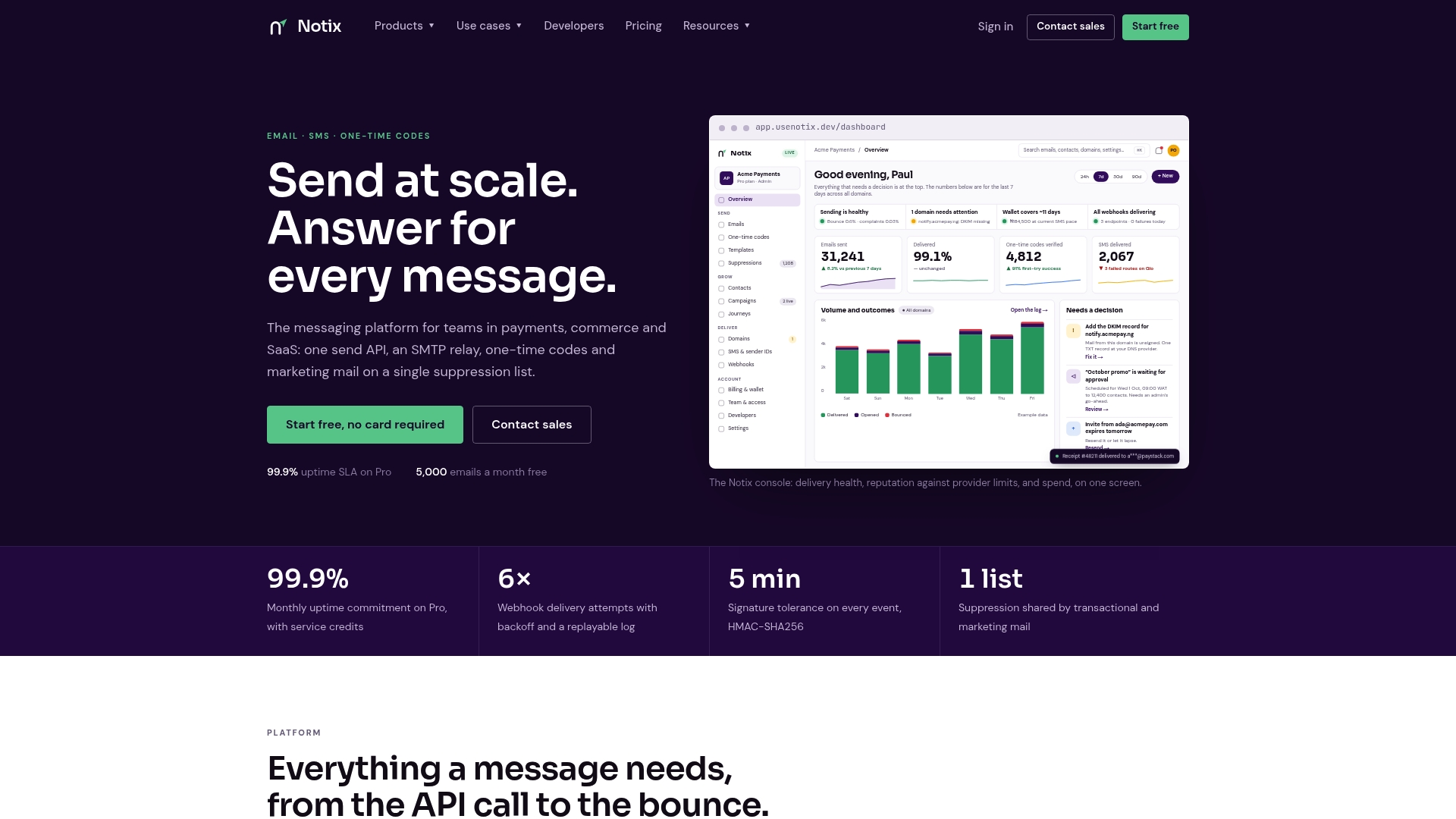
- The Free plan costs $0 per month, useful for testing volume and segment behavior before committing to a paid tier.
- The Pro plan costs $15 per month for teams ready to scale beyond testing.
- Enterprise pricing is available on request for high-volume senders who need custom terms.
Check the Notix pricing page to compare plans against the estimate you built above, or explore the Email API if you are weighing which messages truly need to be SMS.
Sources
The regulatory claims in this guide draw on the FCC's Report and Order, the Federal Register's summary of that rule, and the Federal Register entry on unlawful text messages, which together detail blocking, consent, and recordkeeping obligations for SMS senders. The contrast on free-tier confusion comes from Google Cloud's free program documentation, which shows that general API free tiers do not extend to carrier-billed SMS routing.
- Federal Communications Commission FCC 23-107
- Federal Register, Volume 89 Issue 18 (January 26, 2024)
- Targeting and Eliminating Unlawful Text Messages — Federal Register
- Free Google Cloud features and trial offer | Google Cloud Free Program
FAQ
Is there a free SMS API?
Some providers offer limited free tiers or trial credits for testing, but ongoing SMS sending is billed by carriers and rarely stays free at real volume. Check any provider's published limits before assuming a free tier will cover production traffic.
Is Google SMS API free?
No. As Google Cloud's free program documentation shows, its free tier covers general cloud API usage but does not include a free SMS gateway, since SMS delivery requires carrier billing outside that free tier.
Which SMS API is the cheapest?
The cheapest option depends on your destination mix, message volume, and number type, since per-message rates, number rental, and registration fees all shift the total differently for each sender. Compare full line-item quotes rather than headline per-message prices before deciding.
How to send 1,000 SMS for free?
Most providers do not offer free production messages beyond limited trial credits or free tiers for small-scale testing. Read the specific provider's free-tier terms, since limits on volume, destinations, and throughput vary widely.