

An SMS sender ID is the name or number a recipient sees instead of a random phone number. The alphanumeric version, a branded string up to 11 characters, is one-way only. The United States and Canada don't support it at all, and markets like Australia now require pre-registration before you can use one. Audit your active sender IDs by country before your next international send.
TL;DR:
- Most European, Asian, and Middle Eastern markets support alphanumeric sender IDs, but many now require formal registration before use.
- The US and Canada do not support alphanumeric sender IDs at all, forcing campaigns to use long codes or short codes in these regions.
- Registration for pre-approved sender IDs can take between 4 and 12 weeks, making early planning essential for regulated markets.
- Always match your registered sender ID’s exact casing in API calls to prevent silent delivery failures, especially for carrier routing.
- Combining SMS with email verification in a single platform simplifies compliance, reduces audit complexity, and speeds up registration processes.
Table of Contents
- What Is a Sender ID, and How Does It Differ From a Short Code or Long Number?
- Which Countries Allow Alphanumeric Sender IDs, and Which Block Them?
- How Long Does Sender ID Registration Actually Take?
- How Do You Register and Validate a Sender ID Step by Step?
- What Message Design and Compliance Habits Keep Deliverability High?
- How a Unified Messaging Setup Reduces Sender ID Friction
- Priority Actions for Teams Handling Sender IDs Today
- Get Your Messaging Stack Ready Before Registration Deadlines Hit
- Sources
- FAQ
What Is a Sender ID, and How Does It Differ From a Short Code or Long Number?
A sender ID is whatever identifier shows up on the recipient's screen when your SMS lands. That can be a phone number, a short code, or a branded alphanumeric string like "NOTIX" or "YOURBANK." Each type behaves differently, and picking the wrong one causes more support tickets than almost any other SMS mistake.
An alphanumeric sender ID can be up to 11 characters, must include at least one letter, and can mix letters, numbers, and spaces. It's strictly one-way: recipients cannot reply. That's fine for order confirmations and appointment reminders, but it breaks any flow that expects a text back.
Short codes and long codes (often provisioned as 10DLC in the US) work the opposite way:
- Short codes are five or six digit numbers built for high-throughput, two-way messaging like verification codes or customer support threads.
- Long codes / 10DLC are standard-looking phone numbers registered for application-to-person traffic, cheaper than short codes and also capable of two-way replies.
- Alphanumeric IDs carry brand recognition but shut the door on replies entirely, which means your opt-out and support routing has to happen some other way, usually through a link or a separate number.
If your use case needs a reply, alphanumeric is the wrong tool no matter how good the branding looks.
Which Countries Allow Alphanumeric Sender IDs, and Which Block Them?
Alphanumeric sender ID support is genuinely fragmented, and that's the single biggest planning trap for teams sending across borders. The United States and Canada don't support alphanumeric sender IDs for SMS at all, full stop. So any campaign touching those markets has to fall back to a long code or short code regardless of branding preference.
Most of Europe, plus large parts of Asia and the Middle East, do support alphanumeric IDs, but a growing number of them now require formal registration rather than allowing spontaneous use. A few examples worth knowing:
- Australia: starting July 1, 2026, branded sender IDs must be registered through the SMS Sender ID Register, with telcos onboarding from October 15, 2025 and businesses registering between November 30, 2025 and June 30, 2026.
- Ireland: the ComReg registry governs which businesses can claim a given alphanumeric string, preventing duplicate or impersonating registrations.
- United Kingdom: Ofcom requires providers to verify sender identity through KYC and maintain protected sender lists that block copycat brand names.
Carriers in registered markets don't just reject unregistered traffic outright. Instead, unverified sender IDs in Australia will display as "Unverified" on the recipient's device, which tanks open rates even when the message technically delivers. Regulators are pushing the verification burden upstream onto telcos and messaging providers, which means the businesses that wait until the deadline to register are the ones stuck scrambling.
How Long Does Sender ID Registration Actually Take?
This is where most launch timelines fall apart. Dynamic sender IDs, meaning ones generated on the fly without pre-registration, can go live instantly in markets that allow them. Pre-registered alphanumeric sender IDs are a different story entirely.
Provisioning windows typically run 4 to 12 weeks, depending on the region and the provider handling your submission. Some regions clear registrations in as little as 4 to 5 weeks; others, especially where a government register is involved, stretch closer to the 12-week end.
A few things eat up that time budget:
- KYC verification. Providers need proof your business is who it claims to be before submitting anything to a regulator.
- Regulator review. Bodies like ACMA or ComReg process applications on their own schedule, not yours.
- Carrier vetting. Even after regulatory approval, individual carriers may run their own checks before routing traffic to the new ID.
- Regional provisioning. A sender ID approved in one country doesn't automatically transfer to another; each market usually needs its own submission.
Registration lead times can run anywhere from instant (dynamic IDs) to 4 to 12 weeks (pre-registered alphanumeric IDs), which means a campaign planned six weeks out with a new branded ID in a regulated market is already cutting it close.
The practical fix is staggering rollouts. Register your highest-volume markets first, keep a long-code or generic numeric fallback ready for any country where the alphanumeric ID isn't cleared yet, and never build a launch date around a registration that hasn't been approved.

How Do You Register and Validate a Sender ID Step by Step?
Registering a sender ID is mostly paperwork and patience, but skipping steps causes rejected applications and delayed launches. Here's the sequence that actually works.
- Pick your string and check the format rules. Stay under 11 characters, include at least one letter, and avoid special characters your target carrier doesn't support.
- Confirm country support before you file anything. Check whether your destination market allows alphanumeric IDs at all, and whether it runs a formal register like ACMA's or ComReg's.
- Decide who files the registration. You can go through your telco directly, an enterprise messaging service provider, or an SMS aggregator. Larger providers usually have faster relationships with regulators.
- Submit business proof. Registrars typically want a business registration number, proof of address, and a description of your intended use case.
- Wait for provisioning, then link the ID to your outbound trunk. Once approved, the sender ID must be associated with an outbound trunk before traffic can flow, and your message content needs to match the use case you declared during registration.
- Test on real devices in the target market. Simulators lie. A carrier-level test in the destination country is the only way to confirm the branded name actually shows up correctly.
Pro Tip: Carrier consoles often display your sender ID in all caps, but the backend matching is often case-sensitive. Use the exact casing you registered when calling your provider's API, or you risk silent delivery failures that look like a code bug but aren't.
What Message Design and Compliance Habits Keep Deliverability High?
Registering the sender ID is only half the job. Carriers and regulators are watching what you actually send through it, and a mismatch between declared use case and real content is one of the fastest ways to get an ID throttled.
- Keep message content aligned with the use case you declared at registration; a sender ID approved for shipping notifications shouldn't suddenly carry promotional blasts.
- Include a clear opt-out path or contact route in every message, even though alphanumeric IDs can't receive replies directly.
- Avoid brand names, financial terms, or anything resembling a protected sender string you don't own, since Ofcom-style protected sender lists exist specifically to block impersonation attempts.
- Keep your business registry and KYC records current; stale documentation is a common reason renewal or expansion requests stall.
- If your flow ever needs a reply, whether it's a support conversation or an opt-in confirmation, use a long code or 10DLC number instead of forcing it through a one-way alphanumeric ID.
Pro Tip: Aggregators actively monitor traffic patterns against your declared use case. A sudden spike in volume or a shift in content type can trigger automatic throttling even on a fully registered ID, so treat compliance as ongoing, not a one-time filing.
How a Unified Messaging Setup Reduces Sender ID Friction
Sender ID compliance gets tangled fast when email verification, SMS delivery, and suppression logic live in three different systems with three different audit trails. A unified messaging platform that runs email and SMS through a single API means the same verification workflow that handles one-time codes also maps cleanly onto sender ID provisioning and outbound trunk association.
Double opt-in contact books and automated suppression, shared across both channels, give carriers the kind of consistent, verifiable sending pattern that KYC reviews look for. When a regulator or aggregator asks for proof of clean sending history, having one log instead of three separate ones cuts audit time substantially. Notix backs this with a 99.9% uptime SLA, so registered sender IDs stay reachable once they clear provisioning.

Priority Actions for Teams Handling Sender IDs Today
Start with an audit, not a registration form. List every active sender ID against the countries you actually send to, because that mismatch is where compliance gaps hide.
Then triage by lead time, not by urgency of the campaign. Registrations with 8 to 12 week windows need to start now, while instant dynamic IDs can wait. Gather KYC documentation once and reuse it across markets instead of assembling it fresh for each regulator.
— Paul
Get Your Messaging Stack Ready Before Registration Deadlines Hit
Chasing separate vendors for email verification, SMS delivery, and suppression management is exactly the kind of fragmentation that slows down sender ID audits and KYC reviews. Notix runs both channels through one API, so the verification logs a regulator wants to see already live in one place instead of three.
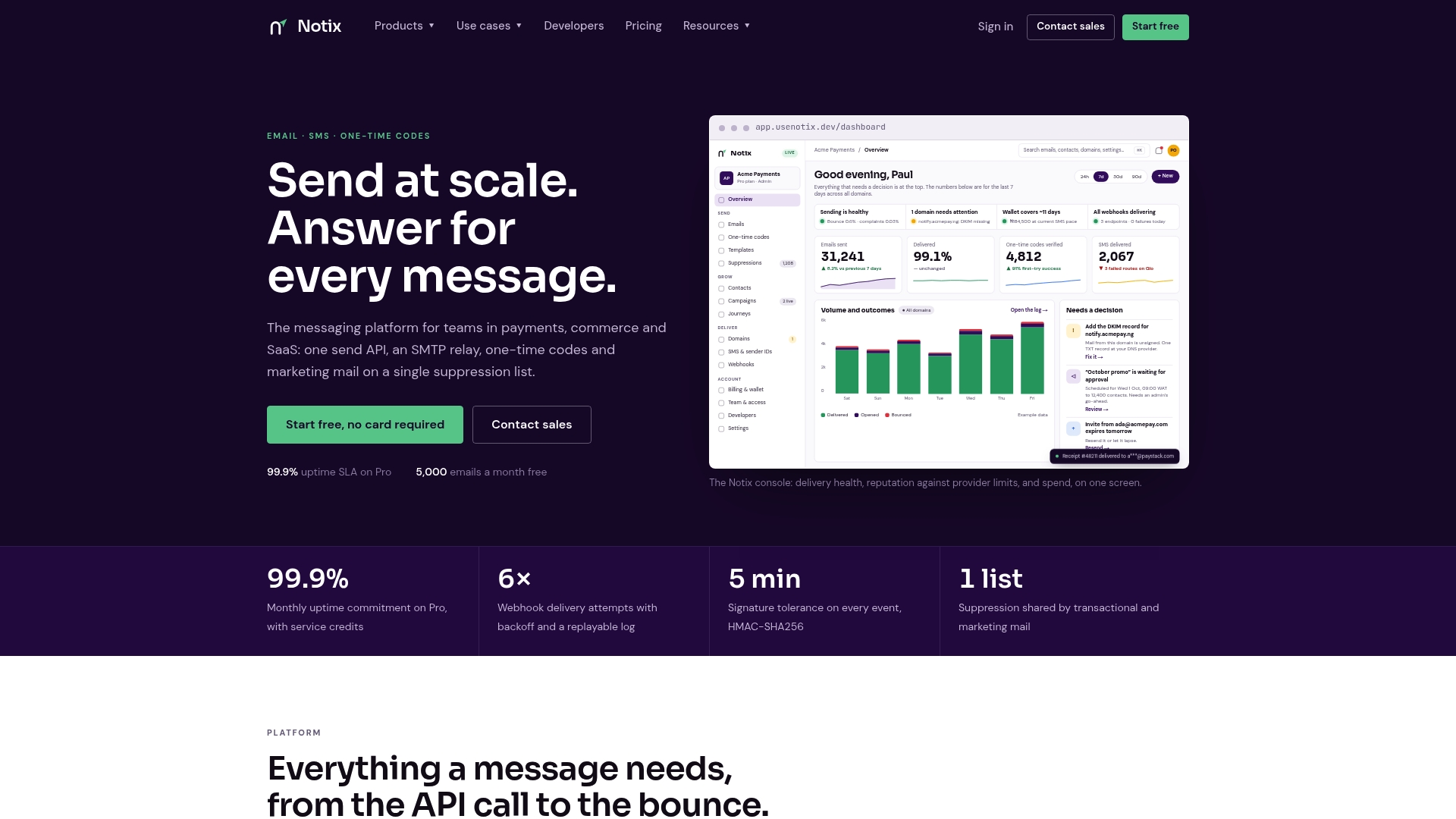
That single-API setup covers one-time code verification, transactional sends, and campaign management, with double opt-in and automated suppression built in to keep your sending history clean for carrier review. Pricing is transparent across the Free, Pro at $15 per month, and Enterprise tiers, so you know the cost before you commit to a pilot. If you're staring down a sender ID registration deadline in any market, start by checking your current setup against the pricing page and see whether consolidating onto one API shortens your next audit.
Sources
- Sender IDs in AWS End User Messaging SMS
- Enable alphanumeric sender ID (Azure Communication Services)
- SMS Sender ID Register | ACMA
- New rules to thwart text message scammers and protect consumers and businesses — Ofcom
- Alphanumeric Sender ID — DIDWW documentation
FAQ
What Is an SMS Sender ID?
An SMS sender ID is the name or number displayed to the recipient instead of a generic phone number. It can be alphanumeric (a branded string up to 11 characters), a short code, or a long code, and the alphanumeric version only works for one-way messaging.
How Can I Find the Sender ID of an SMS I Received?
Check the top of the message thread or the sender field on your phone; it will show either a phone number or a branded name if the sender registered an alphanumeric ID. If it displays as "Unverified," the sender likely hasn't completed regulatory registration required in that market.
What Does "Sender ID" Mean in a Text Message?
It refers to whatever identifies the source of the message on the recipient's device, whether that's a number or a branded name. For businesses, choosing the right sender ID type determines whether customers can reply directly or need a separate contact route.
How Do I Find My Own Sender ID Setup for Outbound Messages?
Log into your messaging provider's console or dashboard, where registered sender IDs and their associated countries are typically listed under your account or number settings. If you're using a platform like Notix alongside SMS providers, check that the registered casing in your account matches exactly what you use in API calls, since mismatches can cause silent delivery failures.
Does Every Country Require Sender ID Registration?
No. Registration requirements vary widely; the US and Canada don't support alphanumeric sender IDs at all, while markets like Australia are moving to mandatory registration by July 2026. Always check the specific country's current rules through your telco or aggregator rather than assuming one region's policy applies globally.